April 24, 2014

Spain to Morocco: A Lesson in Berber Hospitality

Seville is so charming you almost wonder if the whole thing is a practical joke. No city could be so beautiful, with food so delicious, nor be occupied with a people so attractive and pleasant. There has to be a downside, you reason, and it turns out there is one: navigation. Fourteen years of higher education and a detailed city map between Kendra and I and we STILL got lost en route to the Prado San Sebastian bus station for our trip to Tarifa. Spain is not a bad place to be lost, it turns out, and we did manage to snag breakfast from a patisserie, downing delicious cream-filled bignettes, chocolate croissants, and leek quiche on our unplanned tour of the city.


The city, normally gorgeous, was littered with garbage and the street-sweeping crew was out in full force. Apparently we missed the most epic party of the week the night before, and now the whole city was turning out in their best clothes for a massive procession! We were salmon flowing against the stream as we made our way to the bus station. Semana Santa is, without doubt, an activity for the bucket list.


The trip south was pretty, though not nearly as remarkably so as southern Portugal, with exception to the stunning area just outside Tarifa.  We were using a 2010 edition guidebook for the Europe part of this trip, and it turns out that was a mistake. For the ferry crossing to Tangier, Morocco, you want to cross from Tarifa, Spain on the 35 min passenger ferry (by FRS or Inter-Shipping), which costs you either your firstborn child or 65€ roundtrip. Algeciras is now the commercial ferry port, and connects to its Moroccan commercial counterpart of Tangier-Med that's still a ways away from Tangier.
 (Note: Algeciras does, however, link to Ceuta, a Spain-owned portion of Moroccan, er...North African land near Tangier).

So we made the spontaneous (and correct) decision to get off early in Tarifa and catch our ferry from there. Described as a kite-surfer's paradise, the town definitely looked it, and had numerous shops catering to the industry. The port area was decent, however, and had a nice stone fortress we would've liked to explore. Instead, we sat at Olla, a restaurant with over-priced but delicious vegetable pasta, and used the wifi to plan out how to arrive in and navigate Tangier and Marrakech. 


We also typed up Kendra's allergy to seafood and nuts in French and Arabic, which was really helpful as we'd show it to waiters and shopkeepers numerous times during the trip. Add the many stray cats and bee-covered sweets to the mix, and it's clear that Morocco is aiming to take Kendra out.

The high-speed ferry lived up to its name and put its hydrofoils to excellent use jetting across the straight. Walking towards the front, we randomly crossed to the opposite side of the ferry and sat next to a nice Moroccan couple. We would've never guessed it at the time, but this would be one of the best moments of the entire trip. 

The couple, Fatima and Larbi, were actually Moroccan-Americans living in New York who were visiting Morocco and had spontaneously jumped up to Spain for the day. Getting to know them better, they spent half of the ferry ride walking us through Morocco and helping us shape our itinerary. They also gave us their contact information should we need any help while in-country. "What wonderful people!" we thought to ourselves. Little did we know, it would soon seem strange to write about them so impersonally as I am now, because they'd basically become our Moroccan family...

Exiting the ferry, tourists are met with a mob of unfortunately pushy touters, wanting to "guide you," change your money, or simply extort you in some fashion. Fatima and Larbi hung with us and acted as a Moroccan shield from them, then guided us down along the port walkway (about a half mile) to their friends at a nearby restaurant, Al Boughaz. This would be one of many lessons from them - make friends while traveling. Friends can help you when in need, and give you the opportunity to extend grace to others. Their friend Adil, the owner, directed us around the corner and up a steep hill to the nearest ATM where we could withdraw money, instead of having to deal with the hassle of exchanging money back at the ferry. They then invited us back to the restaurant (all of this walking and time during their limited vacation, of course), for some mint tea and maybe a snack at the restaurant.

Little did we know, the snack turned into a seafood feast with mint tea, bread, fries, salad, and giant platters of shrimp and fish. The salad is very unique, as it contains no lettuce, and instead has stripped lunch meat, boiled potatoes, olives and beets. We had a blast chatting with them and learning more about Morocco and their lives. We learned about how they left Morocco when they were recruited by Disney as cultural liaisons for Epcott (awesome), how Fatima makes a mean couscous, how Larbi takes his mint tea (no sugar), and so much more.


Just simply sharing tea with them was wonderful. Hundreds of years ago, a British ship hit a snag and was forced to pull into Morocco's port, selling its tea to the locals. Soon, mint was added and it became inextricably Moroccan, with mint tea time as Moroccan as a post-Tapas siesta is Spanish. The tea is served traditionally very sweet, and to order a pot of it, you say "bread atay."


With the sun beginning to set, Fatima and Larbi continued to astound us with their thoughtfulness by not only covering the meal ("We invited you as our guests") but also dropping us off at the train station via their hired driver! We met them as fellow travelers, but left considering them as though family, truly blessed by their generosity. 

The night train no longer had first class tickets, a tragedy if one plans to actually sleep, so we opted for second class, knowing painfully well what waited ahead. Sometimes, you have to be uncomfortable to greatly enjoy yourself.


We discovered that the train was loading early by mere chance (no announcements), and found two seats on a plastic bench in a green-lit coach. Our restless night was full of incredibly loud announcements on a speaker system in French and Arabic, being awoken multiple times by the ticket checker, freezing cold air through paper-thin windows and repeated crying or cell phone ring tones and the subsequent loud talking. 

Derek, attempting to rest

Since we've done this before, it was like dropping into a trance - if you're new to this, you might consider delaying until better seats are available. Needless to say, you need ear plugs, eye covers, a blanket, and a serious amount of patience to come through in one piece, and we had almost all of those things...you can come to your own conclusions about how we felt in the morning. But no matter - we were in Marrakech, and the gateway to Africa was open wide.


Sevilla Romantica

When I woke up the next morning, my operational tendencies kicked in and my stomach knotted. Derek told me it was 10:30, and when I realized we had only just barely been able to reserve this one room the night before, we rushed down to reserve it again and found, as I feared, that they were fully booked. Once again, our lack of planning caused Maslow's hierarchy of needs to focus our every atom on finding a room in a fully booked city, with no phone or internet, where we easily get lost. We wandered down the street with our bags, kicking ourselves for having been so caught up in the romanticism of Sevilla that we may spend the night upright on the street until dawn.

The first place we stopped, Pension Bailen, told us that they "kind of" had a room. We were intrigued, so we marched up the stairs to the roof to see what was in store for us. A sort of painted shed with a bed and a sink were there, and for 35€ was easily the last "room" in town. We took it (better than sleeping on a street bench, if only barely), only to pass another couple with bags coming in the door for the same reason, just as we left. This reward system for not planning is new to me...it seems that we are always able to find what we need, even when it seems impossible.


Now, for chocolate and churros! I'm a firm believer that donuts are, all on their own, a wholesome breakfast, and always despised that my mother required us to eat a banana to "balance" them. So, when we stumbled on Picatoste and had a giant plate of piping hot churros dipped in mugs of hot liquid chocolate for 6€ (yes, they had a machine that dispersed liquid chocolate like coffee, and when I find out where they manufacture them, I'm most assuredly breaking in and keeping the lot to myself), we were ecstatic.


We got helplessly lost on the way to The Cathedral, so far gone that we almost fell off the edge of the city map, and when we found it, were dismayed to not only find it stuffed to the gills with tourists, but also learned that it would close, due to the holiday, at 2 pm. So, we decided to hit it up on our way back through next week and wandered around the Jardines (gardens) de Murillo to the Monumento de Christobal Colon (we call him Christopher Columbus), where King Fernando and Queen Isabel met him on his return from the New world.


We bought our bus tickets to Morocco to leave the following morning to Algeciras (32.95€ - don't do what we did, go to Tarifa...more to follow) and then went through Barrio Santa Cruz, a twisting, narrow neighborhood known as the "Juderia" because the Jews were forced to live there during the Inquisition. The nearby Parque de Maria Luisa was next, with its expansive botanical gardens and Moorish tile fountains. Inside the entrance, we came across the massive wonder that is the Plaza de España, which was built in 1929 for a world exposition. If it had one, my camera would have turned me into it's union rep for overworking it - Derek was less than thrilled at the time with having to wait for me while I ran around looking for the perfect light, but the pictures justified the delay. See for yourself...


Then, back into the labyrinth barrio for tapas at Bodeguita la Parihuela - melted cheese toast and meatballs and the famous potato "tortilla" (basically potato pie). Every eating and drinking facility is papered with Semana Santa posters, from the current year and years past, showing in up-close detail each mournful float. You can drink the tap water here, so we refilled our bottles in the sink and passed on mid-morning alcohol (as much fun as that sounds). We got lost again, this time very much on purpose, and had excellent Sangria, cinnamon stick and all, on the street outside El Rincon de Murillo cafe.


Since this is Maundy Thursday, all if the Spanish women dress in all black, with high-sitting lace veils, panty hose and fancy handbags. They must be roasting with the heat, but they smile, usually escorted by the arm of a well-dressed man, moving from one cathedral to another to confess, collecting colorful ribbons at each place to pin to their blouse.

Derek is not one to pass up gelato, so a slight misunderstanding between us meant we had a gelato dinner, ordering more than I had realized, and as we sat die to finish it on the steps across from the entrance to The Cathedral (it was easily 7 pm), we noticed that people were not only still being let in (we were told it had closed 5 hours earlier), but that they weren't paying to go in (unheard of). We shoved down our gelato, a tragedy in and of itself, to slip in with the others before they realized their mistake and closed the doors. We were completely taken aback when we realized that, being in the right place at the right time, they had in fact closed early but 're-opened just for one hour because inside the church I'd where ALL OF THE SEMANA SANTA FLOATS pass through to have their candles lit. Christopher Columbus' remains are supported by four heralds in the entryway, symbolizing the four ancient kingdoms if Spain United by Fernando and Isabel.


I'm not proud to say that I had given up on seeing the cathedral, and was wearing a skirt (highly frowned upon). Being more embarrassed for my lack of respect than really thinking clearly, I managed to change into jeans in a corner with the world's largest crowd around me, in a VERY revered place. I'm talented in that regard, but clearly wasn't smart, seeing how my actions, if observed, would have been much more scandalous than the skirt itself. But they weren't. So, I win.

We had a nice dinner on the sidewalk (we always opt to eat outside, with so much to see) at Mesones del Serranito of garlic shrimp and fried cod. Our waiter was phenomenal. Derek was pooped on by a bird (in his hair and on his shirt) and had to excuse himself to clean up while I laughed at his expense.

Back in our room, feeling like our bodies must have aged 40 years in a day, we sat down to rest our sore backs and tired feet...only to have our little closet bed collapse below us.

And so ended our adventure in Seville.

April 23, 2014

Semana Santa

It was an early morning for us. Like zombies, we mechanically got our things together and marched down the dark, quiet streets into the town square. By day, the area is filled with tourists and running children and shops filled with souvenirs, but in the early twilight hours, it is still and silent, with a few haunting shadows making the square seem almost mournful. Paintings of Christ hung between the streets above, the thorny crown evident in them all. They were preparing for Easter, but sweet, small Lagos couldn't light a candle to what was in store for us is awaiting Seville, Spain, where their Semana Santa (Holy Week) is world-renoun.

Our bus (tickets 21€ each) left at 6:30 and we tried to sleep, stopping after a few hours at a rest station which smelled overwhelmingly like flowers, though there were few that could be seen. Derek and I got out to see-saw on the playground (yes, that's right) and did our best to order ham bagels with tomato jam, but were shorted the ham...some things just aren't worth the energy to explain miscommunication. After a 5 hour ride, we arrived in Seville and walked down the street with some hesitation as we learned the road sign placement to Pension Redes, which had probably the last room in the entire town. Semana Santa is no joke - waltzing into town without reservations like we did is not an option, but things seem to be working out for us somehow, in spite of our lack of planning, and we landed a room in a relatively convenient location.

We dropped our bags and were given some helpful advice about the parade route by the lobby attendant, who, seeing by our passports that we are American, told us that we should not be concerned - this was not the Ku Klux Klan. We soon saw why she was worried about our perceptions, as we were passed on the street by a single hooded figure in socks. His tall coned hood covered his entire face, and only small eye holes had been cut. He moved with purpose as several tourists tried to catch quick pictures of him. But there was no reason to be concerned that we'd miss a photo op - there would be many more. We just didn't realize HOW many more!


Wednesday held many processionals, starting at 4 pm. While we waited, we took a stroll down the River Gualdaquivir to see the Plaza de Toros bull ring (for historical and architectural appreciation, because neither of us condone the killing of animals for sport) and the Torre del Oro, both from the outside. This Golden Tower was built by the Almohads in the 13th century and now houses a naval museum.

Torre del Oro

Plaza de Toros

We headed straight for the train station (where we spend an incredible amount of time throughout this two week journey), and by "straight for" I mean that we were actually distracted along the way by a cart selling nutella-filled churros (impulse buy, don't do it. Wait until you find a bakery in town...don't give into your weaknesses like so many have before you). But, of course, the attendant for Lagos was gone, and its lucky that she was, because we sat down at the nearby EFE cafe for fried calamari and meat with tomato sauce that was phenomenal, and decided to delay our departure another day. The wine and hot weather can effect judgement, and not in a bad way!

We followed the procession blockade and saw a few more rogue hooded figures, and even had our fortunes told to us (unwillingly) by women near the center who force rosemary sprigs into your hand and read the lines on the other, showing you with very obvious motions that you'll be pregnant, with such and such gender, happy, and wealthy, etc, speaking loudly over the top of your continued refusal to pay them, or attempts to escape. Since the parade had still not commenced by 5:30 (we found out later that it had, though not in the area we were in), so we hauled our exhausted selves back to the pension for coke and a siesta.

When we awoke, I was terrified that I had missed the procession, but when I stuck my head out of the balcony to see it passing by just a block away, I grabbed my camera in time to catch throngs of hooded mourners, followed by a gigantic float, so large that I couldn't capture it in the picture as it passed between the streets. We followed  the processions all night, seeing float after float of Mary, with painted tears on her face and engulfed in hundreds of candles, and Jesus, on the cross, or carrying the cross, or with Mary. There were 11 total which rounded the city in different areas, which an app outlined in a schedule (a friendly policeman showed us), followed and led by a band and different groups of hooded figures - dressed in black, or purple or white, with cone head covers or sack cloth, no shoes, and huge candles which they used to light the floats when paused for reverence, and which dripped colorful wax coating on the streets and on the clothes of the children who grew tired of holding them consistently. The ceremonies took place every night that week, most nights until 2 am, and some, like Thursday night, until 4 am.


We had Sangria while we chatted with a couple from London on the street as dusk fell, and then grabbed a quick dinner at Cafeteria Rioja (there is no greater tapa than the bacon-wrapped langosteen) amongst the throngs of people. All sorts of people, many very young or very old, out until well past midnight, and we could still hear the band and choral songs creeping into the edges of our dreams.

April 17, 2014

Lagosh that´s a nice beach - Lagos, Portugal

Day three of our trip saw our exit from Lisbon having successfully seen most of the city. Had we been able to stay another day, we would have liked to visit la Basilica Estrella, the Antiquities Museum, and ridden up the Elevator of Baixa to take in the view over a cafe con leche, as well as then explore the adjacent Carmo convent ruins.

After catching another breakfast at Poets Hostel, we made our way to the bus station for the fast-bus ride to Lagos, the city of choice in the major vacation destination that is the Algarve region of Southern Portugal.

Many people, or the otherwise excellent Wikitravel site, will tell you the train is a possible way down. Apparently you shouldn't listen to them. It´s ~28€ compared to the 21€ of the bus, takes longer, involves difficult connections, and uses unreliable regional trains in the Algarve. Instead we took the bus route, which is fast, efficient, and even has wifi-enabled buses (at least until it stops working...)

Finding the fast-bus station to Lagos was a challenge, however. Here´s how you do it (skip below this paragraph if you don´t need the nitty gritty details): walk to the Rossio metro station just north of the Rossio train station at Rossio square. Take the blue line to the jardin zoologico stop, which is also the sete rios stop. once there, follow the signs to the gardens, walking out into a bus stop with the gardens to your left, the bus station in front of you, and a busy multi-lane street to your right as you emerge up the stairs from the underground station. Now turn to have the zoo at your back- on the other side of this street is the actual bus station- notice the yellow walls. That is the back of the building, though, so you have to cross the busy street now in front of you, and then walk over to it and through the parking area, following signs for the billheteria. Here we bought our tickets for the 9am bus, which you can theoretically pre-schedule and purchase online at rede expressos.com. Extremely frustratingly for us, though, our American Mastercard didn´t work so we couldn´t book online in advance. Fortunately, we arrived just in time to make our trip. 

The bus ride was actually incredibly beautiful. Rolling green countryside with intermittent flocks of sheep, innumerable wildflowers, and savanna trees made the hours pass easily. I was planning my move to what was basically an entire region comprised of desktop-wallpaper-worthy photos when we started nearing Lagos.
The view from a bus in Portugal...

TIP: The snack shop near the bus station has wifi
Upon arriving in Lagos, we were actually quite underwhelmed. Kendra and I, whether we truly are or not, fancy ourselves something other than the stereotypical backpackers and tourists you find overseas. We think of ourselves more like "travelers," and upon arriving in Lagos, we were somewhat turned off by the overt embrace of tourism. Heading outside of the town center and its tacky souvenir shops, we found lodging at a nice elderly woman´s hotel/hostel on Rica do Jogo da Bola just up the hill (32 euro).
Despite the heavy handed tourism downtown, Lagos does have beautiful city streets, a little castle, and coastal charm

Eager to get away from the concentration of tourists and towards the stunning beaches of the Algarve, we took off walking along the waterfront.
On our walk we passed by the castle, because every Portuguese city is not complete without one.

... and each also needs a fortress.

 It was only a pleasant 1.5km or so walk, and 500m in, it began to become increasingly rewarding as the red dirt cliffs started to carve their way into the blue waters. This scene, of course, was framed by more wildflowers. 

Don't just settle at the first beach you come to... it gets better.

We didn´t want to pay for transit, so we went to the two beaches within walking distance, which we think were Praia de Piñhao and Praia Camilla. Near the first, Kendra and I were sitting quietly in a cove when a trio of young European ladies clad in bikinis appeared from nowhere and asked me to take lots of photos, as they pranced about in the water. Kendra took a photo of the whole affair and it is really quite hilarious. 
Rough life

At the latter beach, we sat for a long-time  at a restaurant (for a brief time if you're European...)  and had a drink while people-watching. Regarding other possible beaches, Praia Dona Aña looks very nice as well- we could see its cliffs further along the coast, but we chose to bypass the main beach Meia Praia, which was just a simple 4km length of sand across the inlet adjacent to town. Photos the coastline speak for themselves:


 The Portuguese embracing graffiti was appropriate here, though pre-dated a year

Back in town, we needed to find an electrical adapter as the one we brought was on strike. Asking around about where to find one, we were always met with the same answer- the Chinese. "Find the Chinese shop," everyone told us, "they have everything." And they did.

The day ended with Kendra and I having dinner at a very nice Indian restaurant, Maharaja, getting the best palak paneer Kendra´s ever had (including living in Hyderabad for 2 months), then getting gelato while listening to jazz music waft down the Portuguese alleyways.
Pistachio gelato, a cool breeze, jazz music and coastal city streets... not a bad way to unwind from a hard days' beach-going

The happiest place on earth - Disneyland? No. Sintra and Belem

We awoke in our poetry-adorned room at Poets hostel to a lovely included breakfast of ham and spread cheese on toast (very European, Kendra informs me), fresh fruit, coffee, and granola cereal with milk....energy we would need on a jam-packed day in nearby Sintra and the Belem area of Lisbon.
The view from a bus in Portugal...

Sintra is the small seaside hilltop village west of Lisbon and is basically the place where palaces come to retire. A Moorish castle-turned portuguese estate-turned ruins, as well as the pastel-colored Peña palace were the main targets for today. Little did we know our favorite would be the incomparable secret garden mansion that is the Quinta de Regalaira...

But first we had to get there, and trying our hand at Portuguese public transport (though more simple than we make it seem) filled me with more dread than high-school Derek felt talking to girls. We went to the Rossio train station (not to be confused with the rossio metro subway station just further north 100m) and caught an 8€ round trip subway through the countryside 30 min to Sintra. While the view of the journey was uninspiring, it did showcase Portugals´ seemingly universal affinity for graffiti. We got off at the end of the line Sintra station with basically everyone else and went out front to the bus stop to await the 434. It travels in a counter-clockwise direction in a loop that hits our two main targets. Fortunately, we also managed to use it to get to the Quinta as well. It cost 5€ each for the trip, where you can hop off and on at each site but only travel around once.

Immediately we knew we´d love Sintra. It has the cozy yet upscale ambience of Vail combined with the charm and beauty of Italy, but was distinctly Portuguese. Arriving at the Moorish castle on the first bus, we were surprised to be practically the only two to hop off. Getting our tickets, we purchased a combo pass for both the Moorish Castle Ruins and Peña Palace, which was 18€ instead of around 24€ if bought separately.

In front of a tomb

Walking along the path leading to the ruins, we became increasingly excited. Beautiful gray granite boulders sitting in a verdent forest full of birdsong... I could swear I saw five hobbits run by. You reach the lower areas of the estate and start to see remants of the Moorish settlements, with an inscription by King Ferdinand over a tomb stating, "What God made let man not separate," communicating his respect for the Moorish burial sites after the Portuguese took over the castle. 

Passing through the castle walls, you come across the grounds and find two hilltops that you trek up. The ruins are simply astounding, their stone walls overlooking the indescribably beautiful countryside and adjacent hilltop of Peña palace. Hiking around, with the boulders, view, and ruins all combining into one aesthetic, that made us giddy with combined excitement and relaxation. The photos speak for themselvs. I mean, how could a Moorish Castle turned Portuguese palatial residence that was rennovated by  Medieval people not be awesome???

Moorish castle walls with Peña in the background 

Next up was Peña palace. We are extremely glad we got here so early, as later in the day there are throngs of people, enough to be off-putting. This early (10 am), and with our combo pass from the ruins already in hand, we skipped the already lengthening line and got right in. Once in the gardens, you trek up the short but fairly steep hilltop to the palace at the summit. Don´t worry, if hill walking isn´t your thing there´s a 3 euro shuttle to the top. The hilltop even without the place is an ecologic wonder, the Portuguese having terraformed a previously barren hill into a Garden of Eden with over two thousand plant species. Constantly working gardeners gave quiet testimony to maintaining such a unique place. 

Walking up the hillside, you suddenly can't believe your eyes as the pastel colors and arabic dome of the palace greet them. Kendra´s jaw dropped so far that I had to carry it for the next two hours. Peña Palace is like Disneyland for adults in real life. Kendra went on a spree of photos to such an extent that the sparks were flying off the damn thing, capturing all of the incredibly intricate tile work, stone masonry, sculpting. It was the most beautiful building I´ve ever seen, and Kendra said it´s on par with Neuschwanstein. 


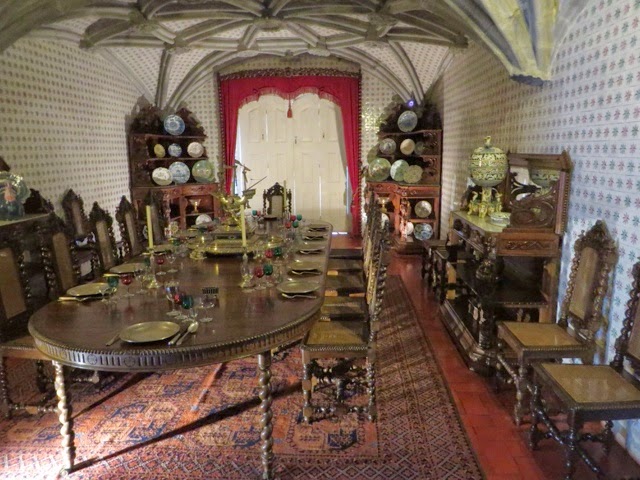
Walking around the perimeter of the castle railing, you see how they intentionally incorporated the hillstop stones into the structure of the castle, giving it the appearance of rising from the hill itself. The chapel on it´s own was worth the price of admission, complete with ornate stained glass, paintings, tile work, sculpted ceilings... we could go on and on. Then inside to the never-ending display of decadent rooms, all replete with elaborate furnitures, scultptures, painting, and ceilings that were themselves works of art. We were overwhelmed upon leaving, and found peaceful moments eating a tomato and mozarella baguette sandwich in the garden below for 2.8€ each.

The centerpiece is a ship made of silver given as a wedding present from Spain

But it wasn´t over.
As the 434 took us back to town, we preemptively got off back at the national palace right before the station, which isn´t a stop on the map for that bus loop but the driver stopped anyway. From there I made the call that we should wander through town and then walk up to the Quinta de Regalaira. Tita, the attendant at Poets Hostel, had said it´s her absolute favorite place in the entire world, and she was raised in Porto and lives in Lisbon, so we knew it had to be good. Sintra is so beautiful, on our walk we even came across a random waterfall straight out of Rivendell from Lord of the Rings. I nicknamed it "Vindication Falls" after Kendra questioned the decision to walk. Shortly after we found the estate and so commenced the greatest visual orgy we've ever experienced. We will subsequently measure the time in our life not by our age but by B.Q. and A.Q. (Before Quinta and After Quinta).


The Gardens alone could occupy pages. We could not believe something so intentionally and deviously and meticously crafted had ever been built. It was as though a child´s imagination occupied Michelangelo´s body and took control of Bill Gate´s savings. Elaborate stone turrets, chapels, fountains, minarettes, and statues were interspersed among grottos, ponds, and innumerable smaller gardens. So why previously did I mention the grounds as being ´devious´? Because as we came across a wall we found a path inside, a path leading into the darkness and upon a tight spiral staircase, up which we ascended into the corner of a chapel. That´s right, the gardens were replete with elaborate secret passageways! 


We wandered from stone structure to structure, strolling along quiet garden paths or ducking down narrow chamberways, climbing so many spiral staircases that we lost count. Wandering to a giant fountain, we found a gateway in the back leading into a deep cave-like tunnel in near complete darkness. Stumbling through, water dripped from the ceiling as we came upon the middle of a 100 foot deep secret well! We were astounded and amazed. Walking down the carved-granite steps to the base, our feet slapping in puddles of water, we found another secret passageway, this one much longer, and leading to a pond with stone steps taking you back into the garden. We could not believe such a place was real.


Impossibly, the estate was even more impressive than the grounds. Commisioned by the capitalist Monteiro to be built as his country home by the architect Manini over twelve years, no detail in the stone, wood, ceiling, or floors was overlooked. The estate also incorporated numerous subtle and overt references to alchemy, the freemasons, heaven and hell, it was eerie, and beautiful, and inspiring all at once. It was simply stunning, on the level of Michelangelo, and so intricate and ornate that I can only show you photos:


Truly overwhelmed by Sintra, we found ourselves back on the train to Lisbon. We wandered down to the 15E bus from Praco do Comercio and now took it headed in the proper direction to Belem. Our excitement offset the fatigue in our legs on the 2.85 euro and 30min long bus ride, a welcome respite from all of our walking. While taking the bus, we watched for the names of each bus stop written on a yellow sign, and got off at the stop for Jeronimos Monastery after the Belem stop. There we found ourselves right in front of the gorgoues cathedral monastery known as Jeronimos monastery. Though the front doors were closed, an open door to the left took us into the tallest cathedral I´ve ever seen, stunning in its stark beauty and also remarkable for the graves of celebrated navigator and portuguese hero Vasco da Gama, as well as poet Luis de Camoes.

Vasco da Gama's final resting place

After Jeronimos, we headed a block to the left to experience the infamous Pasteis de belem. One apparently cannot leave Lisbon without trying them, and the locals tell you to never attempt to order one as you will simply go back and order another six. The custard pastries, flaky on the outside and doughy sweet inside, gave us fuel to walk through a beautiful park towards the Monument of Discoveries, well as the further kilometer down the waterfront to the Tower of Belem, the most famous tower in belem. Moonrise framed the Monument of Discoveries on our return, and we caught the 714 bus back to the Praco, where a tosta mista ham and cheese portuguese sandwich (2.5€) and chocolate croissant (1€) ended the busiest and best day we could´ve possibly had. 


Tower of Belem

Monument of Discoveries