April 17, 2014

Lagosh that´s a nice beach - Lagos, Portugal

Day three of our trip saw our exit from Lisbon having successfully seen most of the city. Had we been able to stay another day, we would have liked to visit la Basilica Estrella, the Antiquities Museum, and ridden up the Elevator of Baixa to take in the view over a cafe con leche, as well as then explore the adjacent Carmo convent ruins.

After catching another breakfast at Poets Hostel, we made our way to the bus station for the fast-bus ride to Lagos, the city of choice in the major vacation destination that is the Algarve region of Southern Portugal.

Many people, or the otherwise excellent Wikitravel site, will tell you the train is a possible way down. Apparently you shouldn't listen to them. It´s ~28€ compared to the 21€ of the bus, takes longer, involves difficult connections, and uses unreliable regional trains in the Algarve. Instead we took the bus route, which is fast, efficient, and even has wifi-enabled buses (at least until it stops working...)

Finding the fast-bus station to Lagos was a challenge, however. Here´s how you do it (skip below this paragraph if you don´t need the nitty gritty details): walk to the Rossio metro station just north of the Rossio train station at Rossio square. Take the blue line to the jardin zoologico stop, which is also the sete rios stop. once there, follow the signs to the gardens, walking out into a bus stop with the gardens to your left, the bus station in front of you, and a busy multi-lane street to your right as you emerge up the stairs from the underground station. Now turn to have the zoo at your back- on the other side of this street is the actual bus station- notice the yellow walls. That is the back of the building, though, so you have to cross the busy street now in front of you, and then walk over to it and through the parking area, following signs for the billheteria. Here we bought our tickets for the 9am bus, which you can theoretically pre-schedule and purchase online at rede expressos.com. Extremely frustratingly for us, though, our American Mastercard didn´t work so we couldn´t book online in advance. Fortunately, we arrived just in time to make our trip. 

The bus ride was actually incredibly beautiful. Rolling green countryside with intermittent flocks of sheep, innumerable wildflowers, and savanna trees made the hours pass easily. I was planning my move to what was basically an entire region comprised of desktop-wallpaper-worthy photos when we started nearing Lagos.
The view from a bus in Portugal...

TIP: The snack shop near the bus station has wifi
Upon arriving in Lagos, we were actually quite underwhelmed. Kendra and I, whether we truly are or not, fancy ourselves something other than the stereotypical backpackers and tourists you find overseas. We think of ourselves more like "travelers," and upon arriving in Lagos, we were somewhat turned off by the overt embrace of tourism. Heading outside of the town center and its tacky souvenir shops, we found lodging at a nice elderly woman´s hotel/hostel on Rica do Jogo da Bola just up the hill (32 euro).
Despite the heavy handed tourism downtown, Lagos does have beautiful city streets, a little castle, and coastal charm

Eager to get away from the concentration of tourists and towards the stunning beaches of the Algarve, we took off walking along the waterfront.
On our walk we passed by the castle, because every Portuguese city is not complete without one.

... and each also needs a fortress.

 It was only a pleasant 1.5km or so walk, and 500m in, it began to become increasingly rewarding as the red dirt cliffs started to carve their way into the blue waters. This scene, of course, was framed by more wildflowers. 

Don't just settle at the first beach you come to... it gets better.

We didn´t want to pay for transit, so we went to the two beaches within walking distance, which we think were Praia de Piñhao and Praia Camilla. Near the first, Kendra and I were sitting quietly in a cove when a trio of young European ladies clad in bikinis appeared from nowhere and asked me to take lots of photos, as they pranced about in the water. Kendra took a photo of the whole affair and it is really quite hilarious. 
Rough life

At the latter beach, we sat for a long-time  at a restaurant (for a brief time if you're European...)  and had a drink while people-watching. Regarding other possible beaches, Praia Dona Aña looks very nice as well- we could see its cliffs further along the coast, but we chose to bypass the main beach Meia Praia, which was just a simple 4km length of sand across the inlet adjacent to town. Photos the coastline speak for themselves:


 The Portuguese embracing graffiti was appropriate here, though pre-dated a year

Back in town, we needed to find an electrical adapter as the one we brought was on strike. Asking around about where to find one, we were always met with the same answer- the Chinese. "Find the Chinese shop," everyone told us, "they have everything." And they did.

The day ended with Kendra and I having dinner at a very nice Indian restaurant, Maharaja, getting the best palak paneer Kendra´s ever had (including living in Hyderabad for 2 months), then getting gelato while listening to jazz music waft down the Portuguese alleyways.
Pistachio gelato, a cool breeze, jazz music and coastal city streets... not a bad way to unwind from a hard days' beach-going

The happiest place on earth - Disneyland? No. Sintra and Belem

We awoke in our poetry-adorned room at Poets hostel to a lovely included breakfast of ham and spread cheese on toast (very European, Kendra informs me), fresh fruit, coffee, and granola cereal with milk....energy we would need on a jam-packed day in nearby Sintra and the Belem area of Lisbon.
The view from a bus in Portugal...

Sintra is the small seaside hilltop village west of Lisbon and is basically the place where palaces come to retire. A Moorish castle-turned portuguese estate-turned ruins, as well as the pastel-colored Peña palace were the main targets for today. Little did we know our favorite would be the incomparable secret garden mansion that is the Quinta de Regalaira...

But first we had to get there, and trying our hand at Portuguese public transport (though more simple than we make it seem) filled me with more dread than high-school Derek felt talking to girls. We went to the Rossio train station (not to be confused with the rossio metro subway station just further north 100m) and caught an 8€ round trip subway through the countryside 30 min to Sintra. While the view of the journey was uninspiring, it did showcase Portugals´ seemingly universal affinity for graffiti. We got off at the end of the line Sintra station with basically everyone else and went out front to the bus stop to await the 434. It travels in a counter-clockwise direction in a loop that hits our two main targets. Fortunately, we also managed to use it to get to the Quinta as well. It cost 5€ each for the trip, where you can hop off and on at each site but only travel around once.

Immediately we knew we´d love Sintra. It has the cozy yet upscale ambience of Vail combined with the charm and beauty of Italy, but was distinctly Portuguese. Arriving at the Moorish castle on the first bus, we were surprised to be practically the only two to hop off. Getting our tickets, we purchased a combo pass for both the Moorish Castle Ruins and Peña Palace, which was 18€ instead of around 24€ if bought separately.

In front of a tomb

Walking along the path leading to the ruins, we became increasingly excited. Beautiful gray granite boulders sitting in a verdent forest full of birdsong... I could swear I saw five hobbits run by. You reach the lower areas of the estate and start to see remants of the Moorish settlements, with an inscription by King Ferdinand over a tomb stating, "What God made let man not separate," communicating his respect for the Moorish burial sites after the Portuguese took over the castle. 

Passing through the castle walls, you come across the grounds and find two hilltops that you trek up. The ruins are simply astounding, their stone walls overlooking the indescribably beautiful countryside and adjacent hilltop of Peña palace. Hiking around, with the boulders, view, and ruins all combining into one aesthetic, that made us giddy with combined excitement and relaxation. The photos speak for themselvs. I mean, how could a Moorish Castle turned Portuguese palatial residence that was rennovated by  Medieval people not be awesome???

Moorish castle walls with Peña in the background 

Next up was Peña palace. We are extremely glad we got here so early, as later in the day there are throngs of people, enough to be off-putting. This early (10 am), and with our combo pass from the ruins already in hand, we skipped the already lengthening line and got right in. Once in the gardens, you trek up the short but fairly steep hilltop to the palace at the summit. Don´t worry, if hill walking isn´t your thing there´s a 3 euro shuttle to the top. The hilltop even without the place is an ecologic wonder, the Portuguese having terraformed a previously barren hill into a Garden of Eden with over two thousand plant species. Constantly working gardeners gave quiet testimony to maintaining such a unique place. 

Walking up the hillside, you suddenly can't believe your eyes as the pastel colors and arabic dome of the palace greet them. Kendra´s jaw dropped so far that I had to carry it for the next two hours. Peña Palace is like Disneyland for adults in real life. Kendra went on a spree of photos to such an extent that the sparks were flying off the damn thing, capturing all of the incredibly intricate tile work, stone masonry, sculpting. It was the most beautiful building I´ve ever seen, and Kendra said it´s on par with Neuschwanstein. 


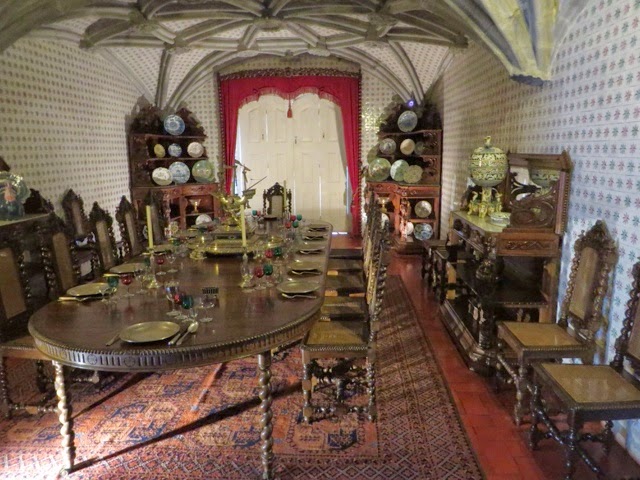
Walking around the perimeter of the castle railing, you see how they intentionally incorporated the hillstop stones into the structure of the castle, giving it the appearance of rising from the hill itself. The chapel on it´s own was worth the price of admission, complete with ornate stained glass, paintings, tile work, sculpted ceilings... we could go on and on. Then inside to the never-ending display of decadent rooms, all replete with elaborate furnitures, scultptures, painting, and ceilings that were themselves works of art. We were overwhelmed upon leaving, and found peaceful moments eating a tomato and mozarella baguette sandwich in the garden below for 2.8€ each.

The centerpiece is a ship made of silver given as a wedding present from Spain

But it wasn´t over.
As the 434 took us back to town, we preemptively got off back at the national palace right before the station, which isn´t a stop on the map for that bus loop but the driver stopped anyway. From there I made the call that we should wander through town and then walk up to the Quinta de Regalaira. Tita, the attendant at Poets Hostel, had said it´s her absolute favorite place in the entire world, and she was raised in Porto and lives in Lisbon, so we knew it had to be good. Sintra is so beautiful, on our walk we even came across a random waterfall straight out of Rivendell from Lord of the Rings. I nicknamed it "Vindication Falls" after Kendra questioned the decision to walk. Shortly after we found the estate and so commenced the greatest visual orgy we've ever experienced. We will subsequently measure the time in our life not by our age but by B.Q. and A.Q. (Before Quinta and After Quinta).


The Gardens alone could occupy pages. We could not believe something so intentionally and deviously and meticously crafted had ever been built. It was as though a child´s imagination occupied Michelangelo´s body and took control of Bill Gate´s savings. Elaborate stone turrets, chapels, fountains, minarettes, and statues were interspersed among grottos, ponds, and innumerable smaller gardens. So why previously did I mention the grounds as being ´devious´? Because as we came across a wall we found a path inside, a path leading into the darkness and upon a tight spiral staircase, up which we ascended into the corner of a chapel. That´s right, the gardens were replete with elaborate secret passageways! 


We wandered from stone structure to structure, strolling along quiet garden paths or ducking down narrow chamberways, climbing so many spiral staircases that we lost count. Wandering to a giant fountain, we found a gateway in the back leading into a deep cave-like tunnel in near complete darkness. Stumbling through, water dripped from the ceiling as we came upon the middle of a 100 foot deep secret well! We were astounded and amazed. Walking down the carved-granite steps to the base, our feet slapping in puddles of water, we found another secret passageway, this one much longer, and leading to a pond with stone steps taking you back into the garden. We could not believe such a place was real.


Impossibly, the estate was even more impressive than the grounds. Commisioned by the capitalist Monteiro to be built as his country home by the architect Manini over twelve years, no detail in the stone, wood, ceiling, or floors was overlooked. The estate also incorporated numerous subtle and overt references to alchemy, the freemasons, heaven and hell, it was eerie, and beautiful, and inspiring all at once. It was simply stunning, on the level of Michelangelo, and so intricate and ornate that I can only show you photos:


Truly overwhelmed by Sintra, we found ourselves back on the train to Lisbon. We wandered down to the 15E bus from Praco do Comercio and now took it headed in the proper direction to Belem. Our excitement offset the fatigue in our legs on the 2.85 euro and 30min long bus ride, a welcome respite from all of our walking. While taking the bus, we watched for the names of each bus stop written on a yellow sign, and got off at the stop for Jeronimos Monastery after the Belem stop. There we found ourselves right in front of the gorgoues cathedral monastery known as Jeronimos monastery. Though the front doors were closed, an open door to the left took us into the tallest cathedral I´ve ever seen, stunning in its stark beauty and also remarkable for the graves of celebrated navigator and portuguese hero Vasco da Gama, as well as poet Luis de Camoes.

Vasco da Gama's final resting place

After Jeronimos, we headed a block to the left to experience the infamous Pasteis de belem. One apparently cannot leave Lisbon without trying them, and the locals tell you to never attempt to order one as you will simply go back and order another six. The custard pastries, flaky on the outside and doughy sweet inside, gave us fuel to walk through a beautiful park towards the Monument of Discoveries, well as the further kilometer down the waterfront to the Tower of Belem, the most famous tower in belem. Moonrise framed the Monument of Discoveries on our return, and we caught the 714 bus back to the Praco, where a tosta mista ham and cheese portuguese sandwich (2.5€) and chocolate croissant (1€) ended the busiest and best day we could´ve possibly had. 


Tower of Belem

Monument of Discoveries

Blitzin´ Lisbon

Landing in Lisbon after a sleepless flight overnight, the pilot announces visibility of just a few hundred feet. Disconcerting, given the beautiful rooftop views required of any visit to Lisbon.  We would see how the day would unfold.
Portuguese buildings are replete with beautiful ajulejos tiles that make an impression even in disrepair.

From the airport, we took the number 1 aerobus down the avenida libertad to the city center, which is the beautiful square otherwise known as Rossio. We recommend taking the metro instead, as it only costs about 1.4 euro to the aerobus´ 3.5 euro, and the ´24 hour aerobuss pass´a ticket purchase grants you is a false promise indeed, as their lines aren´t needed during our visit. Riding down la avenida libertad, however, was quite a welcome to the city. Lisbon certainly makes a powerful first impression, with mosaic tiles and grandiose statues at every corner. While Kendra pulls my sleeve to get me to look at an elaborate fountain, I am too distracted by the storefront of Lamborghini Lisbon. 

Arriving at Rossio square, we were immediately taken by the fountains and architecture. It was wonderful to be in rossio having just been watching Wolter´s World videos of the area from the States just one week prior. Mosaic tiles form a black-and-white wave pattern throughout the square, interrupted by massive statues, and all backdropped by the gorgeous national theater. Opera music from a  nearby restaurant completed the ambience perfectly. 

We wandered down to the rua (street) Augusta towards the equally beautiful Proco do commercial, grabbing a chocolate croissant for 1 euro along the way. 

The Praco is just as easily described by the same flowery language. 

Now feeling the tug of our backpacks on our shoulders, we were in need of a hostel. We headed over to the Living Lounge Hostel, but it was full. Apparently we were short sighted in not booking a hostel or hotel online in advance, we strongly recommend you not repeat our mistake should you make a visit. Google chat with other hostels found an opening at the Poets Hostel. The Poets Hostel was wonderful, with exceedingly helpful staff, organized activities in Lisbon, a great lounge and kitchen, as well as a lovely if spartan room for the night- decorated in marker with the poems of an infamous, schizophrenic Portuguese poet.
Our stay was 40euro for the double and 50 euro the next night in their apt nearby.

After that we took the yellow 28 tram (2.85 Euro) from the stop just outside the hostel. The 28 line is infamous for running along the tourist attractions from the castle san jorge to the basilica estrella. The Yellow are general public and the Red are tourist, but in our rush and jet lag we got on in the wrong direction, worsened still by getting off a stop late and walking back up a hill (walking up and down hills is apparently also a thing in Lisbon...). Still, our irritation with ourselves was tempered by landing at the view point (Miradouros) Das Portos do Sol, where we took in the best view of Lisbon out over the Alfama district as well as the museum for azulejos. 


Now we walked up the hill to the castle San Jorge (tickets 15 euro). A map guided us through the archeological digs, up into the castle tressels,  and along the wall, taking in jaw dropping views of lisbon´s red rooftops, glowing less brightly given the overcast day. 

Reading about the history of the castle was quite interesting, and peacocks showing off in a brilliant display completed the experience. 

Without time to rest we walked down the hill to the Se Catedral, with an awe inspiring compilation of mural paintings, stain glassed windows, and the musky-damp solemnity only found within cathedrals. 

It was a this point that the wheels came off, the second law of thermodynamics kicked in, and everything moved towards chaos, as we tried to make our way to the Belem area of Lisbon. We again got on a tram in the wrong direction, and subsequently tried to get a 6 Euro day pass (for unlimited transit use) but the office was closed. Dejected, Kendra sat on a nearby bench and covered her butt in an unknown sticky substance. It wasn´t the best of times, so we cut our losses and headed back to the hotel to catch a long nap. Waking up refreshed, we walked down to the Baixa area to get pizza. 

Portugal is famous for its wine, and the porto did not disappoint. Warmly spiced in flavor, it's like Portuguese Christmas in a glass and kept us warm on a night tour around the area.


 Dinner was also good energy for a Poets Hostel led tour of Fado. Fado music is part of the heart of Portuguese culture. A mournful genre of almost folk music, Fado was best described by our "guide" Tita when she said, " Fado is very, very sad... it is anguish, lust, despair." Unfortunately, it is also expensive, as many restaurants providing fado singers are quite pricey. Luckily, Tita knew of a place where Fado was free, and we wandered down there along with her lovely parents and two hostel mates to listen to the various Fado singers showcased at POVO restaurant.
If you would like to see Fado Stamos perform yourself, just look for the throngs of swooning women

 Over a tiny glass of Porto wine, we listened to the sorrowful and at times peppy music. Our favorite was the charismatic young man currently completing his residency at Povo, with his boyish good looks quickly earning him  the nickname "Fado John Stamos" or `fado Stamos` for short. It was a wonderful ending to an intense first day in Lisbon.